For every brilliant brain, we ease the strain.
A co-founded assistive technology startup building NestSpecs — AI-powered smart glasses that detect sensory overload in autistic students and autonomously intervene before a meltdown occurs.
Sensory overload is invisible — until it isn't
01 — The problemFor students with Autism Spectrum Disorder, the classroom isn't just an academic challenge — it's a sensory battlefield. Bright hallways, fluorescent lights, and overlapping voices can trigger meltdowns that disrupt learning and erode confidence.
The harder problem: by the time a student shows distress, the overload has already happened.
"How might we give autistic students the autonomy to manage sensory overload in real time — before it disrupts their day?"
Meet Charles
02 — User personaTo ground the problem in reality, we built our primary persona around a composite of real students with ASD. Charles helped our team stay focused on what mattered: not features, but freedom.
Charles
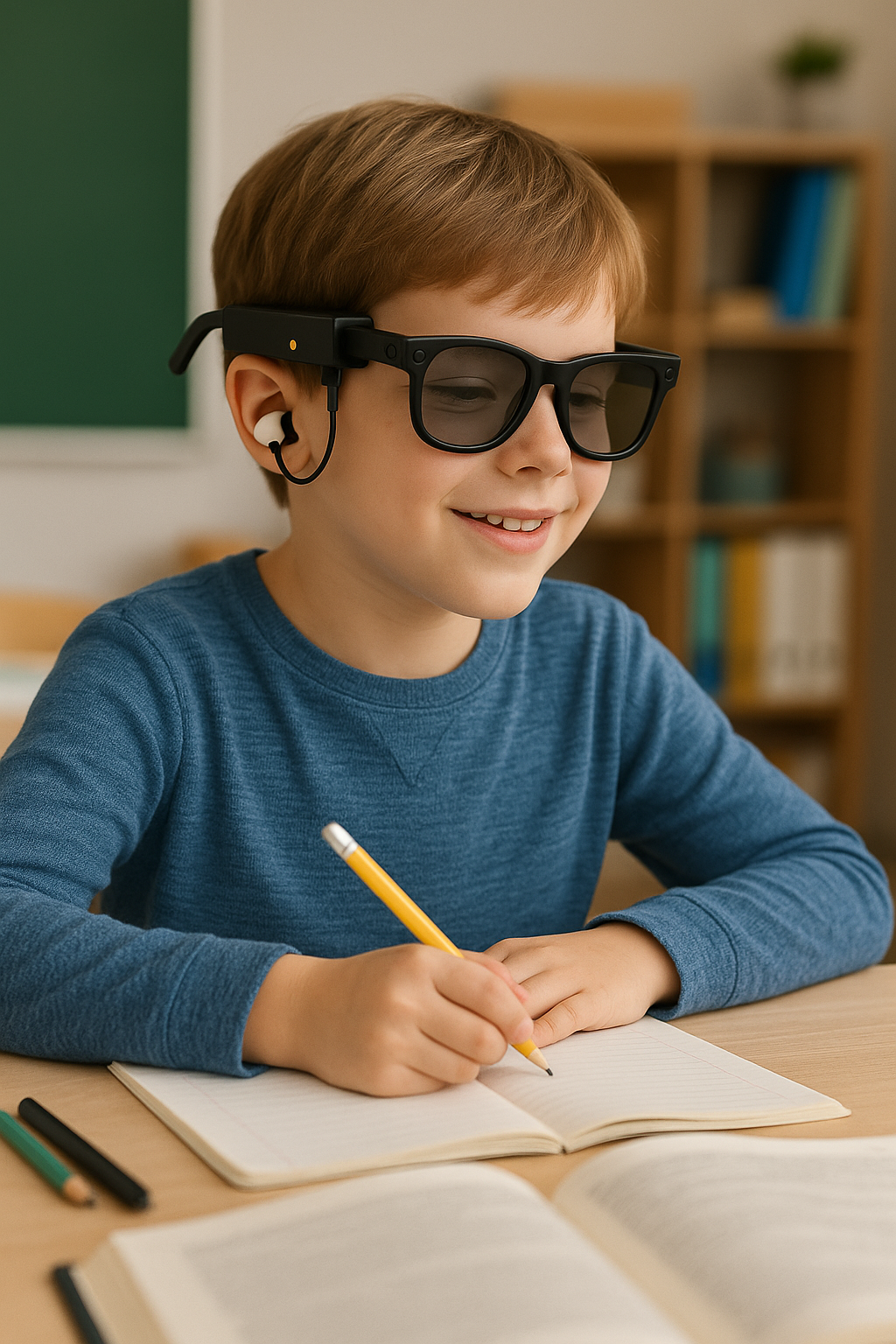
Autistic Sixth Grade StudentCharles loves learning and is excited to see friends at school. But the world around him doesn't always cooperate. Bright sunlight keeps him off the playground at recess. Crowded hallways send him into panic before the school day even starts. He wants independence — not constant supervision.
- Join recess, focus in class, feel calm without needing an aide
- Meltdowns in public, relying on adults, feeling different from peers
- Bright sunlight, crowded hallways, loud overlapping sounds
- Earmuffs, sunglasses — reactive, not preventive
Bright Sunlight
Stops Charles from joining recess with classmates. One of the most common visual triggers among students with ASD.
Crowded Hallways
The noise and motion of a busy school hallway is overwhelming — a daily gauntlet before the first class even begins.
Why existing solutions fall short
03 — Gap analysisThe market for sensory management isn't empty — it's just inadequate. Every solution forces a trade-off between autonomy, adaptability, and real-time effectiveness.
Constant Supervision
Can feel overwhelming and stigmatizing. Limits the student's freedom and autonomy. Not scalable for under-resourced schools.
Low-Tech (Earmuffs, Sunglasses)
Only help after overstimulation — reactive. Target only one sense at a time. Lack adaptability or real-time intelligence.
High-Tech (Limited Options)
Often not designed with children in mind. Lack personalization for daily use. Hard to access and complex to operate.
No existing product proactively detects stress before a meltdown and autonomously intervenes across both visual and auditory channels — while learning the individual wearer's patterns over time.
NestSpecs — AI smart glasses for sensory relief
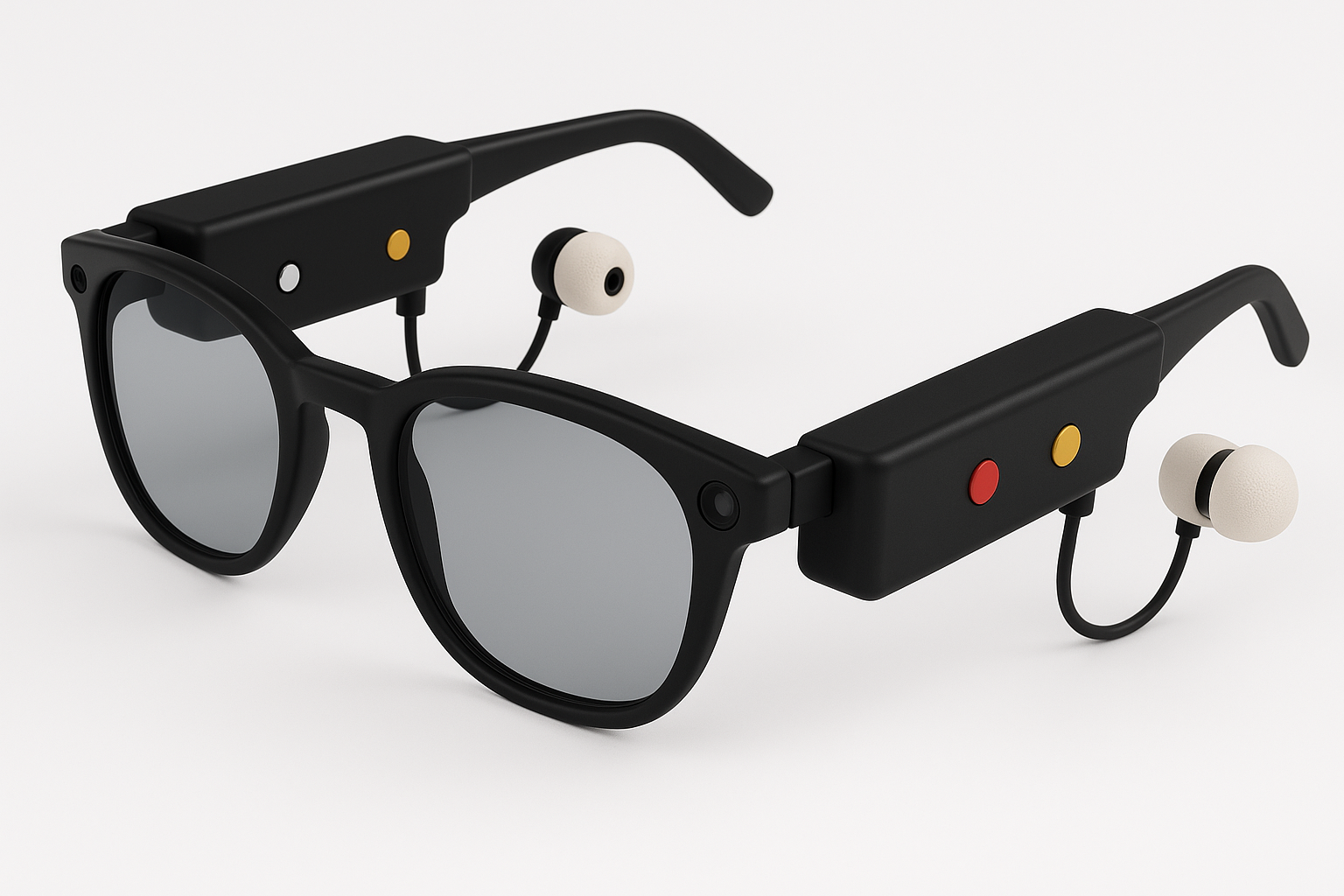
04 — The productNestSpecs are AI-powered smart glasses that continuously monitor biosignals, detect the onset of sensory stress, and automatically intervene — darkening lenses, cancelling sound, and learning the wearer's individual threshold over time. No button presses. No aide required. Just autonomous calm.
AI-Powered Stress Detection
Continuous biosignal monitoring via heart rate, electrodermal activity, and accelerometer data. AI learns each wearer's unique stress threshold over time.
Dynamic Visual Protection
Electrochromic lenses that automatically darken in response to detected light overload — blocking visual triggers without any manual action from the student.
Personalized Learning
The AI model builds a personal sensory profile, getting smarter with every wear — adapting interventions to match each student's specific triggers and patterns.
Adaptive Noise Cancellation
Integrated ANC earbuds that activate when sound triggers are detected — reducing auditory overwhelm in real time without blocking classroom audio entirely.
NestSpecs is built on a licensed patent held by Phoeb-X, Inc. — invented by Dr. David Ruttenberg, a Fulbright Specialist and human-computer interaction researcher who holds 3 related patents. Dr. Ruttenberg was inspired by his daughter's experience with autism to build practical, wearable sensory solutions.
How NestSpecs work
05 — TechnologyThe intervention pipeline runs autonomously in the background. From the moment NestSpecs detects a biosignal spike to the moment an intervention engages, the system operates in milliseconds — before the wearer is even consciously aware of distress.
Biosignal Monitoring
HR monitor and EDA sensor continuously read physiological stress indicators. Accelerometer tracks movement patterns.
Threshold Met
AI model compares readings against the wearer's personal baseline. When the threshold is exceeded, the system activates.
External Sensor Check
Microphones and light sensors identify the environmental source — is it sound, light, or both?
Stimuli Identified
The microprocessor pinpoints which external stimuli are contributing to the overload signal.
Intervention Executed
Electrochromic lenses darken and/or ANC earbuds engage. LED indicator signals the student that help is active.
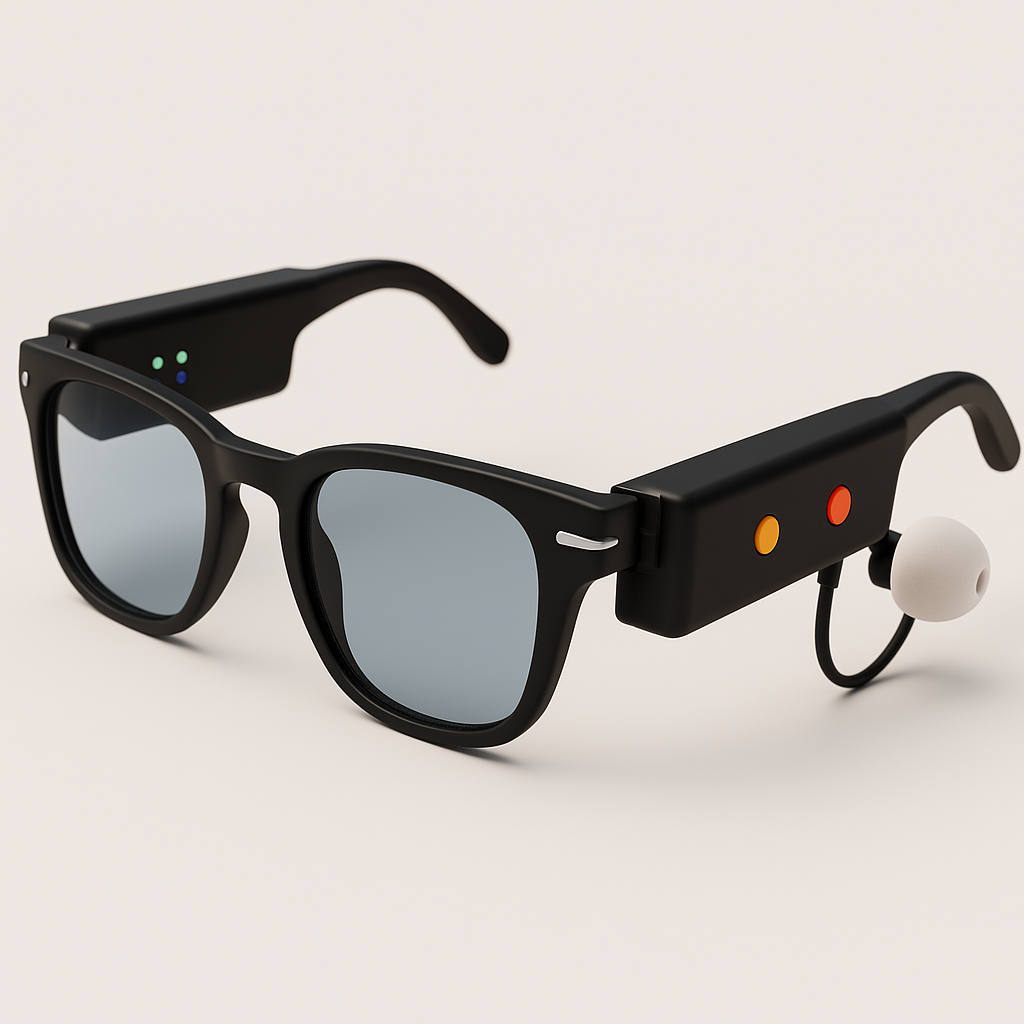
HR + EDA Sensor
Reads heart rate and electrodermal activity for stress detection
Accelerometer
Tracks movement to contextualize physiological readings
Microphones
Environmental audio sensing for sound-trigger detection
Light Sensors
Measures ambient brightness to detect visual overload triggers
Electrochromic Lenses
Auto-darkening lenses that respond to light triggers instantly
ANC Earbuds + LED
Active noise cancellation and visual status indicator
The NeuraNest dashboard
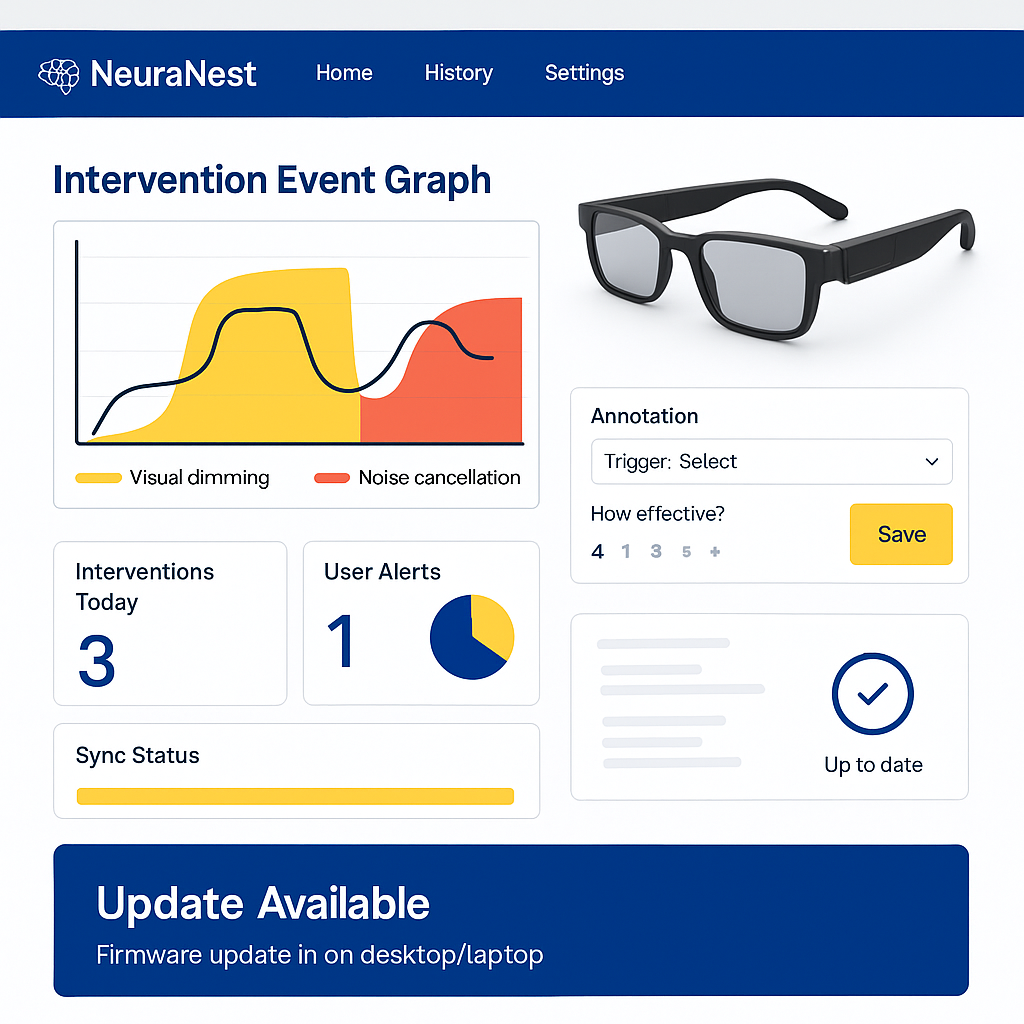
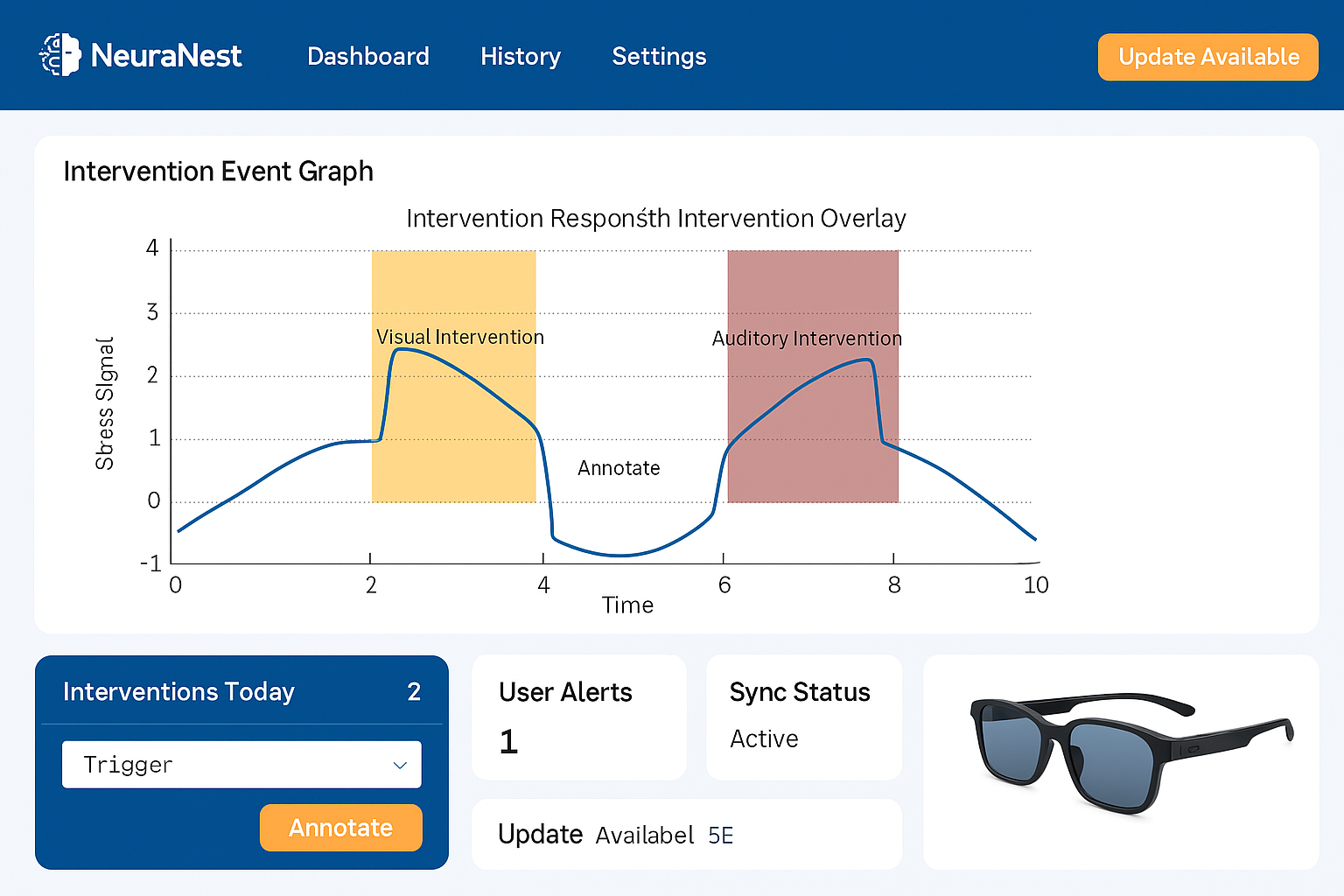
06 — Companion appThe NestSpecs hardware pairs with a companion app that logs every intervention event, tracks biosignal trends over time, and surfaces actionable insights for caregivers and educators — giving them a window into the student's sensory experience without requiring constant supervision.
A large, fast-growing market
07 — Market opportunityThe assistive technology sector is one of the fastest-growing segments in edtech and medtech — driven by rising ASD diagnosis rates, increased awareness, and a shift toward inclusive education policy in the U.S.
New Jersey was chosen as the pilot market due to density of ASD-diagnosed individuals, proximity to team members, and a strong network of schools already invested in assistive tech adoption.
Hardware + subscription
08 — Business modelNestSpecs follows a hardware-plus-SaaS model — a one-time device purchase paired with a monthly subscription that funds AI model updates, cloud sync, caregiver dashboards, and ongoing personalization improvements.
The NestSpecs hardware unit — AI glasses with embedded sensors, electrochromic lenses, and ANC earbuds. Priced to be accessible while covering COGS and margin.
Monthly subscription for AI personalization, model updates, caregiver and school dashboards, cloud data sync, and ongoing product improvements.
Marketing Lead & Co-Founder
09 — My contributionAs the Marketing Lead, I was responsible for shaping how the world sees NeuraNest — from the brand identity and pitch narrative to go-to-market strategy and investor communications. My design background was central to creating materials that made a complex technology feel human and approachable.
Brand Strategy & Identity
Developed NeuraNest's visual language — the blue/yellow color system, logo concept, and brand voice anchored in the tagline "For Every Brilliant Brain, We Ease the Strain."
Pitch Deck Design
Designed and structured the investor presentation — translating dense business plan content into a clear, compelling 10-slide narrative that led with empathy (Charles) before technology.
Go-to-Market Strategy
Defined the New Jersey pilot market strategy, segmented audiences (students, parents, school districts), and outlined channel strategy for outreach and early adoption.
Messaging & Positioning
Positioned NeuraNest against existing solutions by articulating the "proactive vs. reactive" differentiation — a narrative that resonated with both parents and educators.
Stakeholder Communication
Led outreach and communication strategy, liaising between the technical and business teams to ensure marketing materials accurately reflected product capabilities.
Market Research
Synthesized competitive landscape research, user empathy data (Charles persona), and industry statistics to ground every strategic decision in real-world need.
What I learned
10 — ReflectionNeuraNest was my first experience co-founding something real — not a class project with a rubric, but a startup with a patent, a business model, and a genuine market opportunity. The most valuable lesson: empathy is a strategic asset, not a soft skill.
Leading with Charles's story — not the technology spec — transformed how people responded to the pitch. Investors, educators, and parents connected immediately. Every feature, every statistic, and every slide choice was filtered through one question: does this serve Charles?
Translating highly technical product specs (biosignal monitoring, electrochromic lenses, EDA sensors) into marketing language that a parent or school administrator could immediately understand and trust.
Led with the persona first. Built the narrative around Charles's day, not the hardware. Technology became the "how" — Charles's independence was always the "why."
The best product marketing doesn't sell technology — it sells the feeling of a problem solved. For NeuraNest, that feeling was a student walking into a crowded hallway and not being overwhelmed.